Men’s foulard: how to wear It with shirts and tailoring
Summary
The foulard as a sign, not an accessory

The foulard occupies a curious position in menswear because it serves almost no practical purpose anymore. A tie still signals business or formality. A scarf protects against the weather. A foulard does neither completely.
What it communicates instead is intention.
That is why it tends to appeal to men who already feel comfortable within tailoring. The foulard sits somewhere between elegance and nonchalance, which is precisely why so many men abandon it too early. It exposes hesitation immediately.
A silk foulard worn only to “add personality” usually looks forced. The successful versions are quieter than that. They feel embedded in the wearer’s habits, almost incidental, even though the effect is highly deliberate.
This distinction matters.
Many men approach neckwear as the focal point of an outfit. The foulard works differently. It should never dominate the look in the way a bold tie sometimes can. Instead, it softens the transition between shirt, jacket, and skin. It creates continuity.
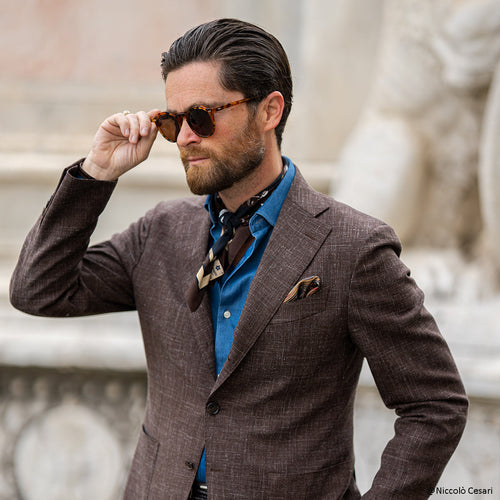
Italian tailoring has understood this for decades. A printed silk foulard worn beneath a softly structured navy jacket introduces movement into the chest area without disturbing the silhouette. The effect is relaxed, but not casual.
That nuance is difficult to achieve with conventional neckwear.
The best foulards do not announce confidence aggressively. They suggest ease through proportion, texture, and restraint.
The relationship between neck, collar, and shirt
A foulard changes character completely depending on the shirt around it.
This is where many men get the balance wrong. They focus on the silk itself while ignoring the structure supporting it.
A stiff business collar often works against the natural fluidity of a foulard. The silk becomes trapped. The folds lose softness. What should feel relaxed starts to look constrained and overly deliberate.
At the opposite extreme, an excessively soft or lightweight shirt can create the opposite problem. Without enough structure underneath, the foulard collapses into itself and loses definition by midday.
The most convincing combinations usually sit somewhere between those two extremes.
An Oxford cloth button-down, for instance, introduces enough texture and body to support the silk while still feeling relaxed. Soft spread collars also work particularly well, especially when paired with unstructured tailoring. What matters is not formality, but balance.
The relationship between cloths is equally important.
Dry silk or silk-cotton blends tend to pair beautifully with brushed wool, linen, flannel, and washed cotton because the textures complement one another naturally. High-shine silk against rigid worsted suiting, on the other hand, can sometimes feel too sharp and overly polished.
As a general rule:
- softer collars create better drape
- textured shirts support silk more naturally than overly smooth poplins
- relaxed tailoring almost always works better than rigid construction
The foulard should feel integrated into the architecture of the outfit rather than sitting on top of it as decoration.
That is the difference between style and styling.

Volume, lightness and presence
Silk exaggerates proportion very quickly.
Good balance looks effortless. Bad balance looks theatrical immediately.
One of the most common mistakes with a men’s foulard is excessive volume around the neck. Too much fabric creates visual heaviness at the centre of the body, interrupting the line from collar to chest. Instead of elegance, the result feels performative.
Yet too little presence creates another issue entirely. A foulard that disappears beneath the collar often looks accidental, as though the wearer added it at the last moment without conviction.
The ideal lies somewhere in between: enough body to hold shape, enough lightness to move naturally.
This is why fabrication matters more than many realize.
Printed silk with a slightly dry hand tends to drape more elegantly than overly glossy silk satin. Silk-cotton blends are particularly effective because they retain shape while avoiding excessive shine. Older archival-style bandanas often work beautifully for the same reason: they carry texture and softness simultaneously.
A useful reference is the traditional Italian foulard designed to sit imperfectly beneath an open collar rather than form a rigid knot. The point is not precision. In fact, slight asymmetry usually improves the result.
A simple way to judge the balance:
- put on the shirt and jacket first
- tie or fold the foulard naturally
- step back and look at the chest line as a whole
If the eye goes immediately to the knot, reduce the volume.
If the foulard disappears entirely, introduce slightly more body or texture.
The goal is presence without insistence.

Colour as continuity
Colour should behave the same way texture does: naturally and without interruption.
The most elegant foulards rarely rely on aggressive contrast. Instead, they extend the palette already present within the outfit. The effect is more atmospheric than decorative.
This is where many men misunderstand how to style a foulard.
Because it occupies a relatively small area of the outfit, they often assume it should provide the boldest colour. In reality, highly saturated silk around the neck can fragment the entire composition. The eye stops too abruptly at the foulard itself.
More convincing are colours that already belong to classic menswear.
Washed navy, tobacco, olive, deep burgundy, charcoal, and faded earth tones tend to work particularly well because they enrich tailoring quietly rather than interrupting it. These shades also flatter the complexion more naturally than brighter primary colours.
Pattern follows the same principle.
Small paisleys, geometric repeats, archival prints, and softly muted motifs generally age better than high-contrast contemporary graphics. They create depth without demanding attention.
There is also a practical consideration here. A foulard inevitably sits close to both the face and the shirt collar, meaning excessive contrast becomes visually amplified very quickly.
The most refined combinations usually feel tonal rather than dramatic.
A navy foulard against a faded blue Oxford shirt.
Olive silk beneath tobacco linen tailoring.
Burgundy patterns sitting inside brown wool.
Nothing feels isolated. Everything speaks the same language.
For readers interested in this softer approach to colour and print, Fumagalli 1891’s archival foulards and bandanas remain particularly strong examples of how historical motifs can still feel contemporary when handled with restraint.
What men often get wrong
The irony of the foulard is that it only works when it stops looking intentional.
Most mistakes happen when men try too hard to communicate sophistication through it.
The problems are usually predictable:
- collars that are too rigid
- knots that are too precise
- silk that is too glossy
- excessive volume at the neck
- colour contrast designed to attract attention immediately
The result often feels less like personal style and more like costume.
A good foulard should introduce ease into tailoring, not complexity. It should feel slightly imperfect, as though it settled into place naturally during the day rather than being adjusted repeatedly in front of a mirror.
This is also why softer tailoring tends to support foulards better than highly structured suiting. Neapolitan jackets, washed linen, suede outerwear, brushed wool, and textured shirting all share a certain relaxed visual rhythm that silk can complement beautifully.
Sharp business suiting rarely offers the same harmony.
The solution is almost always restraint:
- softer structure
- quieter colour
- less volume
- more texture
- fewer adjustments
Let the cloth do the work.

A more personal way to dress
The enduring appeal of the men’s foulard lies in what it represents within modern menswear: a movement away from rigid formality without abandoning elegance altogether.
It offers something ties often cannot anymore — individuality without noise.
That is why the foulard continues to resonate with men drawn to softer tailoring and more personal forms of dress. It introduces nuance into an outfit. A sense that the wearer understands proportion, texture, and ease rather than simply following rules.
And unlike louder luxury signifiers, a well-worn foulard rarely seeks immediate attention. Its elegance emerges gradually, through movement, fabric, and the way it interacts with the rest of the wardrobe.
That subtlety is precisely what gives it longevity.
When paired with the right shirt, balanced in the right proportion, and chosen in colours that belong naturally within classic menswear, the foulard becomes more than an accessory. It becomes part of a man’s visual language.
For those exploring this quieter approach to elegance, Fumagalli 1891’s men’s foulards offer a compelling example of how archival craftsmanship can still feel entirely modern today.