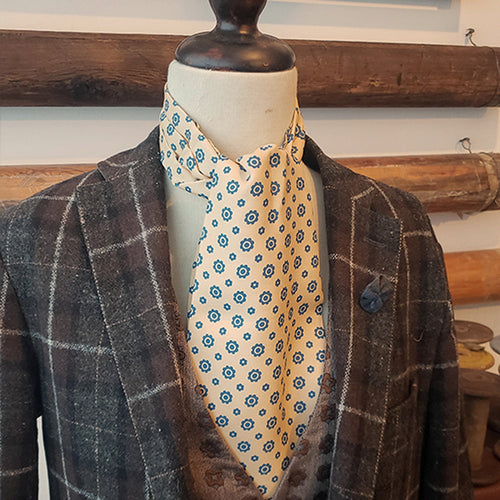
Light, colour, and matter in the most subtle season
Spring never arrives abruptly. It announces itself before it fully appears: in the quality of the morning light, in the softened way fabrics begin to behave, in the gentler perception of volume and contrast.
In this context, the tie ceases to be a purely formal device and becomes something closer to a regulator of atmosphere. It does not complete an outfit in a decorative sense; it calibrates it. Worn beneath an unstructured jacket or with an open-collared shirt, it does not interrupt the seasonal continuity—it refines it.
Muted blues, powdery greens, and breath-like beiges are not a seasonal palette in the conventional sense, but rather a perceptual adjustment. Light changes first; colour follows without resistance.
Spring does not express itself through intensity, but through the reduction of contrast. Visual distances compress, edges soften, and what once appeared sharply defined becomes more fluid, more open to interpretation.
Within this shift, the tie does not introduce formality: it recalibrates it. Often it becomes the only truly structured element within an otherwise relaxed silhouette—yet this structure must never feel rigid.
On a city morning, beneath a lightweight jacket in fresco wool or silk-linen, the knot is not read as a formal imposition, but as a point of equilibrium. A controlled presence, never assertive.
Muted blues, powdery greens, breathable beiges. Light fabrics that do not cover: they respond.
Colours more than dyes
The most accomplished spring ties are distinguished not by brightness, but by atmospheric depth. These are colours that do not immediately declare themselves; they reveal their character gradually, through movement and changing light.
Blue, in this season, loses vertical rigidity. It settles onto the fabric like a veil rather than a statement. Green becomes less botanical and more mineral—filtered, as if through pale urban dust. Beige, perhaps the most elusive, shifts entirely between interior and exterior light, morning and afternoon.
These are colours that do not seek definition, but relationship.
The distinction between a seasonal tie and a truly spring tie lies in its materiality.
Silk, when handled with structural lightness—open weaves, airy gauzes, non-saturated surfaces—does not reflect light; it allows it to pass through. This fundamentally alters how the piece lives on the body.
A denser fabric tends to stabilise. A lighter one behaves differently: it remains mobile. It follows the movement of the shirt, reacts to temperature shifts, and subtly changes throughout the day. It is never exactly the same object twice.
It is precisely this controlled instability that makes it feel contemporary.
Spring as balance
In a spring wardrobe, the true subject is not lightness itself, but the relationship between lightness and structure.
A well-chosen tie does not remove formality; it makes it more permeable. It does not diminish authority; it refines it. In this sense, the act of tying it becomes less ritualistic and more functional.
In an urban context—a morning meeting, a short journey, a transition between indoors and outdoors—the tie does not assert status, but maintains coherence between elements that would otherwise drift apart.
It does not close the outfit; it holds it in balance.
Spring naturally encourages a fragmentation of the wardrobe into lighter components. Yet this is precisely where imbalance can occur.
Light scarves, pocket squares, silk foulards, braces: each introduces variation, but none should operate in isolation.
The scarf accompanies movement. The pocket square introduces a visual pause. The foulard adds fluidity, almost a change in rhythm. Braces restore essential geometry without heaviness.
Within this system, the tie becomes the point of cohesion. It does not dominate—it organises.
The risk of overlap
As material density decreases, the risk of visual overlap increases. One of the most common misreadings of the season is to interpret lightness as accumulation.
But spring elegance is never additive. It is selective.
In a well-composed outfit, a single anchoring element is often enough to define the tone of the whole. Everything else must remain subordinate to an invisible hierarchy.
When every detail seeks attention, none truly receives it.
Coherence as a principle
Coherence is not uniformity of colour or style. It is a perceptual continuity between elements that share the same idea of balance.
A tie may differ from a pocket square, a jacket from a shirt. Yet what binds them is the same intention: not to interrupt the natural flow of the silhouette.
When this coherence is achieved, the outfit no longer appears constructed. It appears inevitable.
Conclusion
Within the contemporary spring wardrobe, the tie has not lost relevance. It has simply changed role.
It is no longer a marker of formality, but a measure of control. It does not define style; it stabilises it. It does not conclude an ensemble; it preserves its equilibrium as everything else becomes lighter.
It is in this intermediate space—between structure and dissolution, intention and ease—that its presence becomes most compelling. Not because it is noticed, but because it prevents everything from dispersing.