Some journeys begin on a road, others in a photograph. There are moments in which travel, sport and the landscape seem to meet naturally, leaving behind images that continue to speak long after the moment itself has passed.
This is a journey through the world of the automobile, the historic 1000 Miglia and the visual language that grew around it: roads, movement, colour, freedom and the quiet anticipation before the
start.
The car is already on the road. Green, polished, its number clearly visible along the side. A little further ahead, another car seems to be waiting its turn, while a third can just be seen beyond the bend. None of them is moving fast. Perhaps that is what makes the scene so compelling: automobiles built for speed, still for a moment before the start, before the noise, before the road becomes a racetrack.
Around them, the landscape follows an entirely different rhythm. Trees reach the edge of the road, the water opens beyond the vegetation, and in the distance the houses follow the line of the shore.
Some people are watching, others seem simply to be waiting. The race has not yet begun, yet everything needed to imagine it is already there.
In the 1920s, the automobile still possessed the fascination of something new: it meant speed, travel, discovery and elegance, a new way of crossing the landscape and looking at the world. Roads acquired a new dimension and the journey itself became part of the experience, as automobiles began to leave behind an imagery shaped by sport, movement and freedom.
It is also for this reason that these images still possess such particular force today. They do not simply tell the story of a race, but of an era learning to see speed as something new. The number painted onto the bodywork, the uniform of someone waiting along the route, the vivid colour of a car against the green of the trees or the blue of the water: simple details, yet together they create a scene that seems to continue beyond the edges of the photograph.
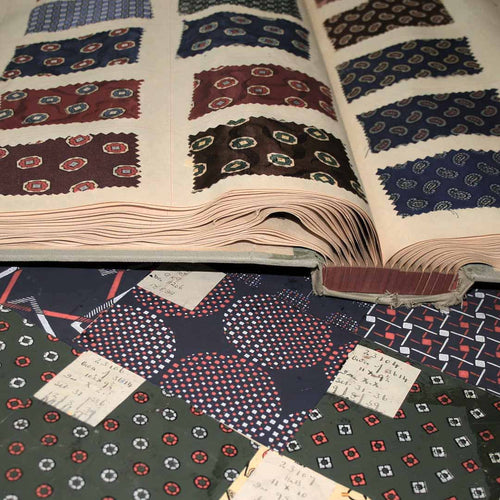
That same visual language would eventually find its way far beyond the racetrack, into posters and illustrations, into objects and textiles capable of preserving its shapes, colours and atmosphere. Not as a reproduction of the past, but as a visual memory that can be reinterpreted and carried into the present.
It is often the smallest detail that holds the gaze the longest. We take in a photograph as a whole, and only after a moment do we begin to notice a line, a particular shade, a figure in the background that had escaped us at first. The scene slowly changes as we look at it, much as it does when contemplating a beautifully composed textile: the design reveals itself from a distance, then gains depth as we draw closer.
At that point, the design ceases to belong solely to the surface and becomes part of what we wear.
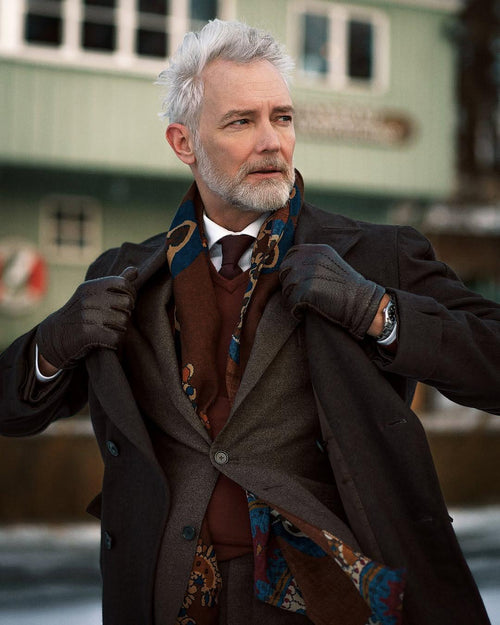
A colour may appear quietly beneath the lapel of a jacket, while a motif follows movement without demanding attention. The softness of wool around the neck introduces something more intimate, almost private, and what began as a distant image suddenly becomes part of everyday life.
It is not about wearing a race, or carrying with you the image of an automobile. Rather, it is about recognising, in those colours and forms, something belonging to a particular way of experiencing travel, movement and leisure; an imagery that needs no explanation in order to be recognised.
Perhaps this is why certain images manage to travel through time. Not because they describe an era with precision, but because they preserve something of the way it looked at the world, allowing those who observe them to enter it once again, if only for a moment.
The car is still there, on the road.
The water catches the light and the landscape continues beyond the bend. The eye returns to the bodywork, then moves towards the colour, the pattern, the small detail that had remained in the background before.